

What does Jesus stand for?
That question is more searching than it first appears. It is not asking what Jesus taught — though His teaching changes everything. It is not asking what Jesus did — though what He did is the hinge of all history. It is asking about the deepest convictions that drove Him, the things He would not be moved from, the purposes that brought Him to earth and carried Him to the cross. What were the Causes that animated the life of the Son of God?
We have covered significant ground in this series. The Character of Christ asked us the most personal question — what are we becoming? The Connections of Christ pressed us on how we relate — the qualities that mark those who genuinely belong to Jesus. And the Community of Christ called us to examine what we are like together — not just a gathering of individuals, but a living organism, shaped by the Spirit, sent into the world as a witness.
But there is something beneath all of that. Something that explains why character matters, why connections matter, and why community matters. Jesus was forming people in His likeness for a purpose. He was shaping His disciples so that they could stand for what He stood for — and carry it into every room, every neighbourhood, every corner of a world that desperately needs to encounter it.
That is what this next part of the journey is about.
The Kingdom Programme
There is a moment in Luke 4 that functions like a declaration of intent. Jesus stands in the synagogue at Nazareth, unrolls the scroll of Isaiah, and reads — The Spirit of the Lord is upon me, because He has anointed me to proclaim good news to the poor. He has sent me to proclaim liberty to the captives and recovery of sight to the blind, to set at liberty those who are oppressed, to proclaim the year of the Lord's favour (Luke 4:18–19). He rolls up the scroll. He sits down. And He says the sentence that silences the room — Today this Scripture is fulfilled in your hearing.
He was not reading a passage. He was announcing a programme. Everything that followed — the healings, the meals with the marginalised, the confrontation with religious structures that had buried people under burdens they were never meant to carry, the cross itself — was the outworking of what He declared in that synagogue. The Causes of Christ are not separate items on a list. They are dimensions of a single magnificent intention, seeded in the heart of the Father before the foundation of the world and embodied in full in the Son.
What matters to Jesus is that those who bear His name understand what He came for — not in the abstract, but in the practical, costly, daily reality of a life surrendered to His purposes.
The Approach
To guide our exploration of the Causes of Christ, we will examine four aspects that capture what drove Jesus at the core of His mission. These are recoveries of what was always there in His life and ministry, waiting to be drawn out, held up, and taken seriously by a people called to continue what He began. Each one will receive its own careful exploration.
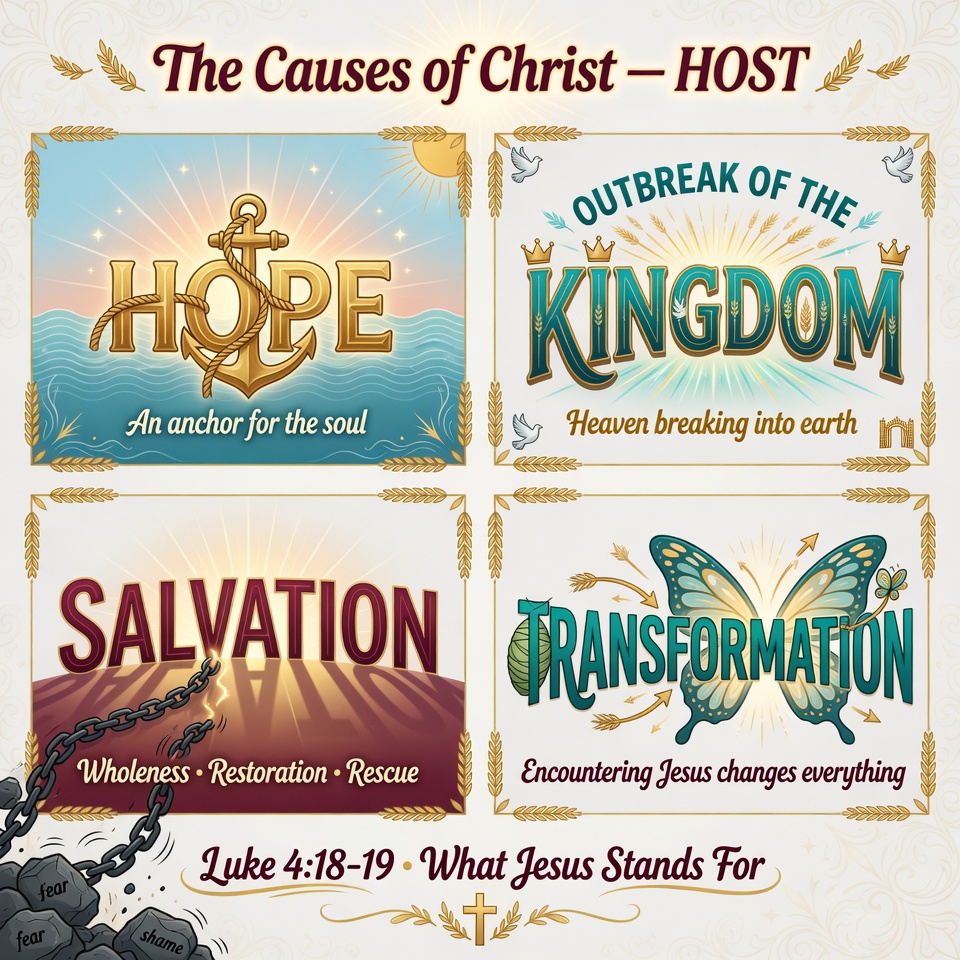
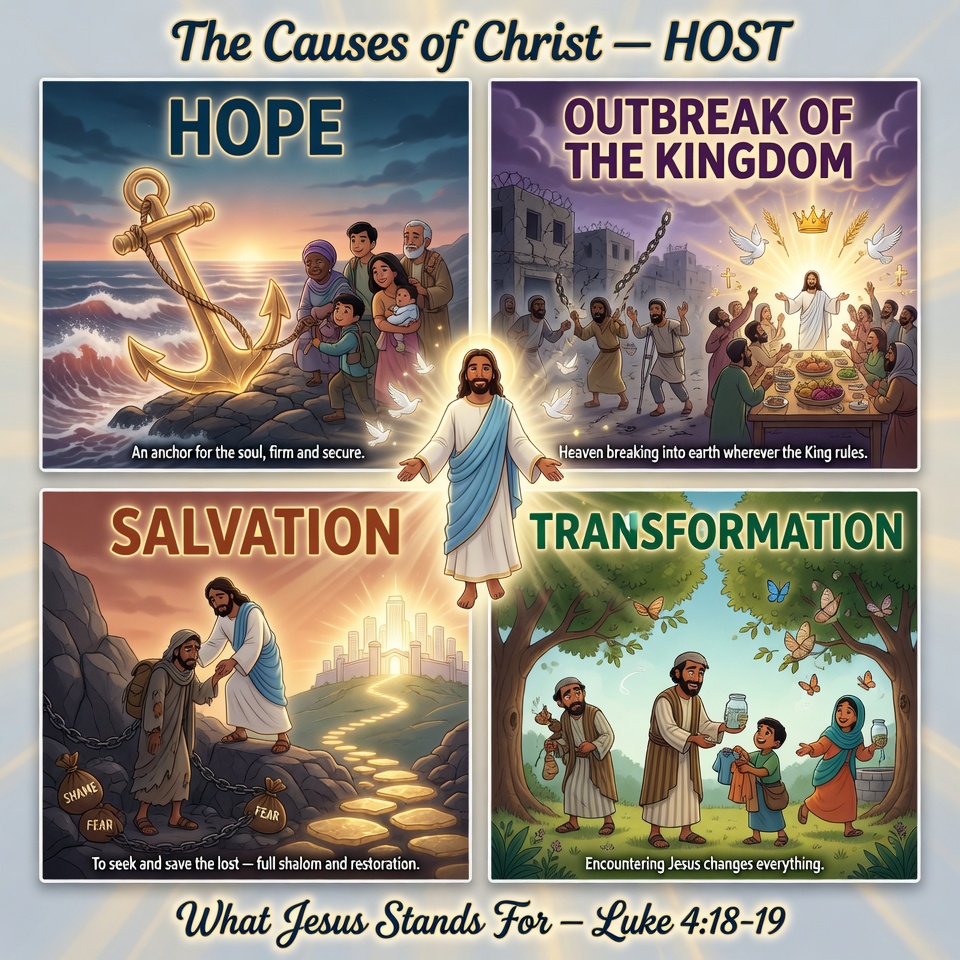
Hope. The world Jesus entered was not merely inconvenienced. It was crushed under the weight of futility — people with no anchor for the soul and no reason to believe the long darkness would ever lift. Jesus carried something into every room He entered that the world had not seen in its fullness: a living, certain, unassailable hope. Not optimism in religious clothing, but the hope that Paul described as an anchor for the soul, firm and secure (Hebrews 6:19). That hope was one of the most disruptive things about Him. And it is one of the most urgent things His people are called to carry today.
Outbreak of the Kingdom. Wherever Jesus went, the rule and reign of God broke through. The sick were healed. The demonised were freed. The excluded were welcomed to the table. He called it the Kingdom coming — not a distant future event alone, but a present reality pressing its way into the world through those surrendered to the King. The Outbreak of the Kingdom is the lived experience of a people through whom heaven insists on making itself visible on earth.
Salvation. The word can lose its weight through overuse. But salvation in the hands of Jesus was always shalom — wholeness, restoration, the putting right of everything that had gone wrong between God and humanity, and within the human person. He came to seek and to save the lost (Luke 19:10) — and that saving was never merely a transaction. It was the rescue of a life from one dominion and its restoration to another. Salvation is one of the great Causes of Christ — and it demands from His people both a passion for the lost and a clarity about what it truly means to be found.
Transformation. Jesus never left people the way He found them. The woman at the well returned to her city with a testimony. Zacchaeus came down from his tree a different man. Transformation is not the ambition of an ambitious church programme — it is the natural consequence of a genuine encounter with the living Christ, and one of the deepest longings of the human heart, whether or not that heart knows to name it. His people are not only called to experience transformation themselves. They are called to be agents of it.
Hope. Outbreak of the Kingdom. Salvation. Transformation.
What matters to Jesus is not just that we know these things. It is that we live them — visibly, urgently, at cost — in a world that His Father so loved that He gave His Son for it.
We will begin by exploring what it means to carry the Hope of Christ...
For His Name's Sake
C. L. J. Dryden
Shalom
Next Steps
Reflect: Read Luke 4:16–21 slowly. Sit with the deliberateness of what Jesus declared in that synagogue. Which of the four aspects — Hope, Outbreak of the Kingdom, Salvation, Transformation — do you feel most alive to in your own walk with Christ? And which have you perhaps kept at a comfortable theological distance?
Pray: Lord Jesus, you stood in that synagogue and announced what you had come for. You were not offering one option among many — you were declaring the purposes of the Father, and staking your life on them. Help us to understand and embrace those purposes as our own. Where we have reduced the Causes of Christ to concepts, make them convictions. Where we have held them at arm's length, draw us in. We want to stand for what you stand for — for your glorious name's sake.
Act: This week, take one of the four aspects of the HOST and ask a trusted friend or fellow believer this single question: where do you see this Cause most needed in our community right now?